
By: Megan McDowell, DNP, MSN, RN, CNE, Nurse Educator and Co-Founder, Track My Clinical
Beyond the Checkbox: How AI Could Transform Clinical Competency Assessment in Nursing Education
Are we simply documenting what nursing students do, or are we truly measuring what they're learning?
Throughout my career as a nurse educator, I've spent countless hours reviewing clinical evaluations, assessing skills, and documenting student progress.
And I've often wondered: Are we collecting information simply to demonstrate that students completed their clinical requirements, or are we truly using that information to understand their development as future nurses?
Think about the traditional clinical skills checklist. A student successfully performs a skill, the instructor signs off, and another box is checked.
But what does that checkmark actually tell us?
It tells us the student demonstrated a particular skill at a particular moment in time. What it doesn't necessarily tell us is whether that student understands the clinical reasoning behind the intervention, can recognize potential complications, or can apply that knowledge in a different patient care situation.
As nurse educators, we know there's a significant difference between completing a task and demonstrating clinical competence.
And yet, much of our clinical documentation continues to focus on recording what students have done rather than helping us understand how they're progressing.
We're Collecting Data, But Are We Connecting It?
Consider how much information we collect about nursing students throughout their clinical education.
We document clinical experiences, evaluate performance, assess psychomotor skills, provide feedback, and measure achievement of course and program learning outcomes.
The information is there. The challenge is that it often exists in different places.
One instructor may document a student's performance during a clinical rotation. Another may complete a skills checkoff in the simulation lab. A third may provide valuable feedback during a subsequent clinical experience.
Each assessment offers a glimpse into the student's development. But how often do we have the opportunity to connect those individual observations into a meaningful picture of their overall progression?
And perhaps more importantly, how easily can we identify students who are struggling with particular competencies before those gaps become significant?
For nurse educators already balancing teaching responsibilities, clinical supervision, student support, and administrative demands, finding time to review and connect all of this information can be challenging.
Moving From Task Completion to Competency Development
The shift toward competency-based nursing education challenges us to rethink how we assess student learning.
The American Association of Colleges of Nursing (AACN) Essentials emphasize the development and demonstration of competencies throughout nursing education. This approach focuses not simply on whether students have been exposed to certain content or experiences, but on whether they can demonstrate the knowledge, skills, and abilities necessary for professional nursing practice.
I believe this is an important distinction.
For example, consider a student who has successfully completed a medication administration skills checkoff.
That's an important accomplishment. But competency goes beyond demonstrating the steps of medication administration.
Can the student recognize when a medication should be withheld? Can they identify a concerning assessment finding? Can they explain the rationale behind the intervention? Can they recognize an adverse response and determine the appropriate next action?
Clinical competence requires students to integrate knowledge, psychomotor skills, clinical judgment, and decision-making in real patient care situations.
That development doesn't happen during a single skills checkoff or evaluation. It happens over time, through repeated experiences, feedback, reflection, and opportunities to apply learning in increasingly complex situations.
Our assessment processes should help us recognize and support that progression.
Connecting Clinical Experiences to Measurable Learning Outcomes
Another challenge in nursing education is demonstrating how the experiences students complete in clinical, skills labs, and simulation contribute to achieving course and program learning outcomes.
We know students are gaining valuable experiences, but how effectively are we connecting those experiences to the competencies they're expected to achieve?
Consider a student caring for a patient experiencing a change in clinical condition.
During that experience, the student may demonstrate assessment skills, clinical judgment, communication, prioritization, and patient safety practices.
That single experience can contribute to multiple course learning outcomes, program learning outcomes, and competencies outlined in the AACN Essentials.
But if we're simply documenting the clinical activity or checking off individual skills, we may be missing the opportunity to demonstrate how that experience contributes to the student's overall competency development.
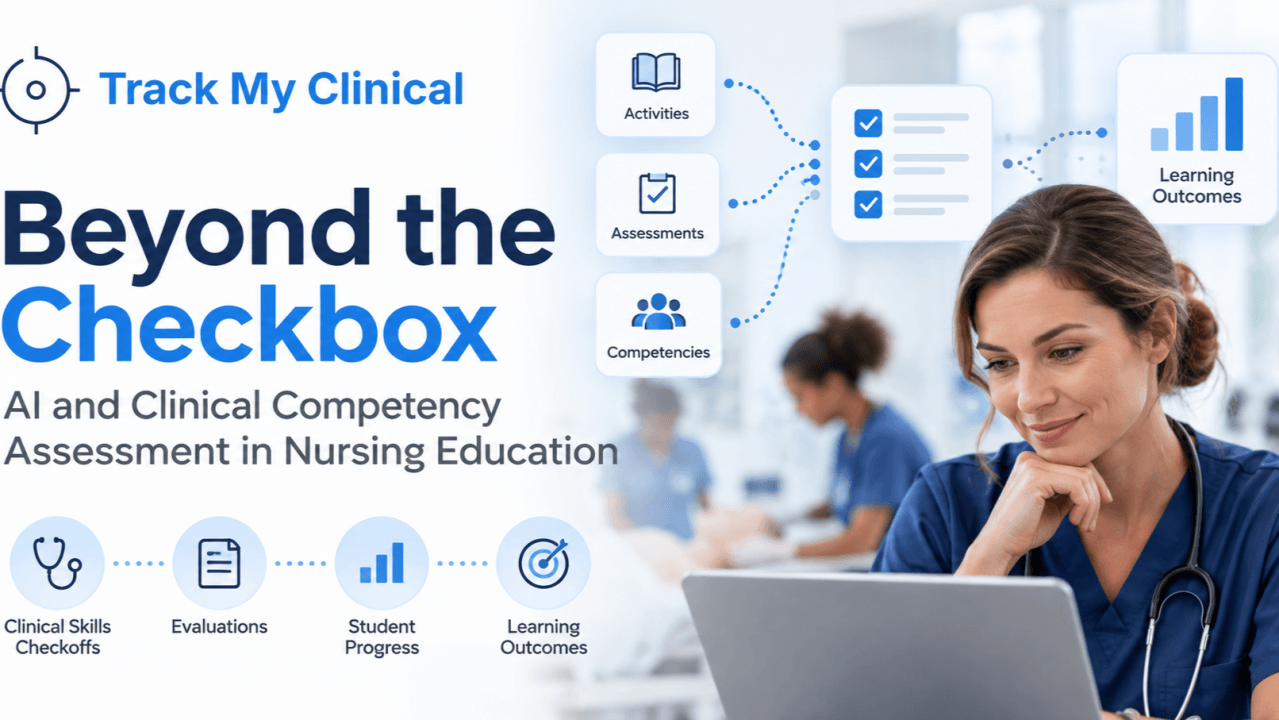
This is an area we've focused on with Track My Clinical: creating the ability to connect what students actually do in clinical, skills labs, and simulation to the learning outcomes and competencies established by their nursing programs.
By aligning clinical activities, skills checkoffs, and evaluations with course learning outcomes, program learning outcomes, or the AACN Essentials, educators can gain greater visibility into student progression and achievement of established benchmarks.
This information is equally valuable at the program level.
Nursing program leadership needs to understand not only whether individual students are progressing, but also whether competencies are being introduced, reinforced, and assessed at appropriate levels throughout the curriculum.
Connecting these activities to measurable outcomes can help programs identify gaps, evaluate curriculum alignment, and demonstrate how students are progressing toward expected competencies.
It also provides a more organized way to gather evidence that supports program evaluation, continuous quality improvement, and accreditation requirements.
Rather than scrambling to connect the dots when accreditation reviews approach, what if programs could more easily demonstrate how clinical learning experiences align with expected outcomes throughout the educational journey?
For me, that's where technology has the potential to make a meaningful difference. It's not just about documenting what students do. It's about understanding how those experiences contribute to developing safe, competent, practice-ready nurses.
Where Artificial Intelligence Could Make a Difference
This is where I see tremendous potential for artificial intelligence in nursing education.
When we talk about AI in education, much of the conversation focuses on academic integrity, student use of generative AI, and concerns about students becoming overly dependent on technology.
Those are important conversations. But I believe we're missing another opportunity.
What if AI could help nurse educators make better use of the information we're already collecting?
At Track My Clinical, we've already begun addressing this challenge by connecting clinical activities, skills checkoffs, and evaluations to course learning outcomes, program learning outcomes, or the AACN Essentials.
Now, imagine building on that foundation with artificial intelligence.
AI could help educators analyze information across those connected experiences, identify potential learning gaps, recognize patterns in student performance, and highlight areas where students may need additional support.
For example, imagine a student who successfully completes several psychomotor skills but consistently receives feedback about difficulty prioritizing patient care or recognizing changes in patient condition.
Looking at each evaluation individually, that pattern might not be immediately apparent. But when those observations are connected across multiple experiences, educators could gain valuable insight into where additional coaching or learning opportunities may be needed.
For program leadership, AI could eventually provide greater visibility into competency development across courses and student cohorts, helping identify curriculum gaps, evaluate progression toward established benchmarks, and inform continuous quality improvement initiatives.
It could also help faculty identify which competencies are being assessed frequently and where students may need additional opportunities to demonstrate learning.
The goal isn't simply to collect more data.
It's to turn the information we already collect into meaningful, actionable insights that support student learning and program effectiveness.
The Nurse Educator Must Remain at the Center
I want to emphasize something important: I don't believe AI should determine whether a nursing student is clinically competent.
That responsibility belongs to qualified nurse educators who understand the complexity of nursing practice and can evaluate student performance within the appropriate clinical context.
AI cannot replace the professional judgment of an experienced instructor who recognizes that a student's hesitation may reflect uncertainty, anxiety, a knowledge deficit, or an unfamiliar clinical situation.
Nor can it replace the mentorship, constructive feedback, and encouragement that help students develop confidence and clinical judgment.
What AI can potentially do is support the work surrounding those decisions.
It can help organize information, reduce repetitive administrative tasks, assist with assessment alignment, and bring relevant observations to the educator's attention.
Of course, any use of AI in clinical assessment must also include appropriate safeguards for student privacy, data accuracy, transparency, and faculty oversight.
Technology should enhance our ability to educate, not replace the human judgment that makes nursing education meaningful.
Why This Matters to Me
One of the reasons I co-founded Track My Clinical was my own frustration with the amount of time nurse educators spend managing clinical education processes.
I know firsthand how much work happens behind the scenes to coordinate clinical experiences, document learning, evaluate student progress, and ensure program requirements are being met.
I've also experienced how challenging it can be to connect individual student experiences to the bigger picture of course outcomes, program outcomes, and accreditation expectations.
And I've always believed that educators should be able to spend more of their time doing what they do best: teaching, mentoring, and helping students develop into safe, competent nurses.
That's part of what motivates the work we're doing with Track My Clinical.
By bringing clinical activities, skills checkoffs, evaluations, and learning outcomes together, we're working to help educators better understand student progression while giving program leadership greater visibility into how clinical learning supports curriculum benchmarks and expected competencies.
As we continue developing the platform, we're also exploring how AI can help simplify the integration of evaluations and skills checkoffs and make the information collected throughout clinical education more useful.
For me, this isn't about incorporating AI simply because it's the latest technology.
It's about addressing challenges I've experienced throughout my own career in nursing education.
How can we reduce the administrative work associated with clinical assessment while giving faculty and program leaders better information to support student success?
I believe there's an opportunity to do both.
Looking Beyond the Checkbox
As nursing education continues to evolve, I think we need to ask ourselves an important question:
Are our assessment processes designed primarily to document completion, or are they helping us understand and support the development of clinical competence?
Both documentation and assessment are necessary. But they aren't the same thing.
A completed checklist tells us something happened.
A meaningful assessment helps us understand what a student learned, how they've progressed, and what they need to continue developing.
And when we can connect those assessments to course learning outcomes, program learning outcomes, and established competencies, we begin to see a much more complete picture, not only of individual student development but also of how effectively our nursing programs are preparing future nurses.
Perhaps the greatest opportunity AI offers nurse educators isn't the ability to automate another task, but the potential to give us more time and better information to support the students entrusted to us.
I'd love to hear from other nurse educators and nursing program leaders:
If technology could take one task off your plate related to clinical evaluations, competency assessment, or accreditation reporting, what would it be?
And what challenges do you encounter when trying to connect clinical experiences, skills checkoffs, and student learning outcomes?
Dr. Megan McDowell, DNP, MSN, RN, CNE, is a nurse educator and co-founder of Track My Clinical, a clinical education management platform designed by nurse educators to simplify clinical processes, connect learning experiences to educational outcomes, and support nursing students, faculty, and program leaders.
Reference: American Association of Colleges of Nursing. (2026). The Essentials: Core Competencies for Professional Nursing Education. https://www.aacnnursing.org/essentials
Portions of these materials are taken from The Essentials: Core Competencies for Nursing Education (“The Essentials”), which is owned by the American Association of Colleges of Nursing (“AACN”). A full copy of The Essentials and the terms and conditions for downloading can be found at https://www.aacnnursing.org/Essentials/Download-Order. Except as otherwise provided in the AACN downloading terms and conditions, The Essentials may not be distributed in whole or in part to any third parties without express written permission from AACN. Any licensing of The Essentials by AACN does not constitute or imply any endorsement of any company and/or any of its products, services or written work product. AACN is not responsible for any errors or omissions in the translation or reproduction of The Essentials by any third party.