
While most healthcare education programs recognize the importance of competency mapping, implementing it can be incredibly time-consuming.
Many faculty members still rely on spreadsheets, paper evaluations, or manually cross-referencing assignments with competencies or program learning outcomes. Clinical coordinators and educators often spend countless hours tracking which activities support which outcomes, gathering evidence for accreditation, and compiling reports across multiple courses and clinical sites.
As programs grow, so does the complexity.
A single clinical evaluation may measure several competencies. One assignment may support multiple program learning outcomes. Multiply that across dozens of students, multiple instructors, clinical sites, and semesters, and curriculum mapping quickly becomes difficult to manage manually.
Turning Documentation into Meaningful Data
Technology can transform competency mapping from an administrative burden into an ongoing part of the educational process.
Instead of documenting clinical experiences in one system and tracking competencies somewhere else, educators can link them together from the beginning.
When clinical skills, evaluations, assignments, simulations, and other learning activities are mapped directly to competencies or program outcomes, every completed evaluation contributes meaningful evidence of student learning.
Faculty no longer have to reconstruct that information later for program review or accreditation; they have been collecting it all along.
How Track My Clinical Supports Competency-Based Education
At Track My Clinical, we designed our platform with competency-based education in mind.
Programs can map clinical skills, assignments, evaluations, and other learning activities to the framework that best fits their curriculum. Whether your program follows the AACN Essentials, state board competencies, institutional learning outcomes, profession-specific standards, or your own program learning outcomes, Track My Clinical allows you to build those relationships directly into the platform.
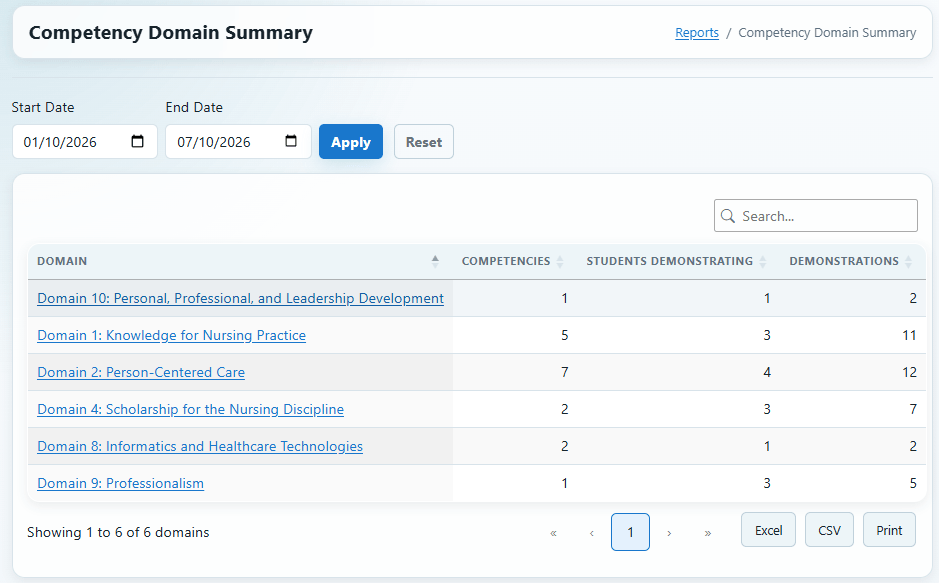
As faculty complete evaluations or students submit assignments, the associated competencies are automatically documented, creating a continuous record of student achievement.
Instead of maintaining separate spreadsheets or manually matching assignments to outcomes, everything is connected in one place.
Saving Faculty Time
Nursing and allied health educators already wear many hats: teaching, advising, grading, scheduling, accreditation preparation, committee work, and clinical coordination. Administrative tasks should not consume hours that could be spent supporting students.
By integrating competency mapping into everyday clinical documentation, Track My Clinical helps reduce repetitive administrative work.
Faculty can:
- Link skills, evaluations, assignments, simulations, and clinical activities to competencies or program outcomes.
- Customize competency frameworks to match their program's curriculum.
- Document evidence of student achievement as part of routine evaluations.
- View student progress across competencies throughout the program.
- Generate reports without manually compiling data from multiple sources.
- Better prepare for accreditation and continuous quality improvement initiatives with organized, searchable documentation.
Instead of spending hours gathering evidence before an accreditation visit or curriculum review, faculty have access to data that has been collected throughout the student's educational journey.
The Future of Clinical Education
Competency-based education is not simply another accreditation requirement, it is an opportunity to better understand how students learn and where programs can improve.
When clinical documentation, evaluations, assignments, and competencies work together, educators gain more than completed paperwork. They gain actionable insights that support student success, strengthen curriculum decisions, and simplify program assessment.
That is the philosophy behind Track My Clinical. We believe technology should do more than digitize forms; it should reduce administrative burden, provide meaningful data, and give educators more time to focus on what matters most: preparing the next generation of healthcare professionals.
To learn more or book a demo, visit trackmyclinical.com. Megan can be reached at megan@candor360.com.
The Essentials: Core Competencies for Professional Nursing Education, a publication owned by the American Association of Colleges of Nursing, may be accessed at https://www.aacnnursing.org/Essentials/Download-Order .