
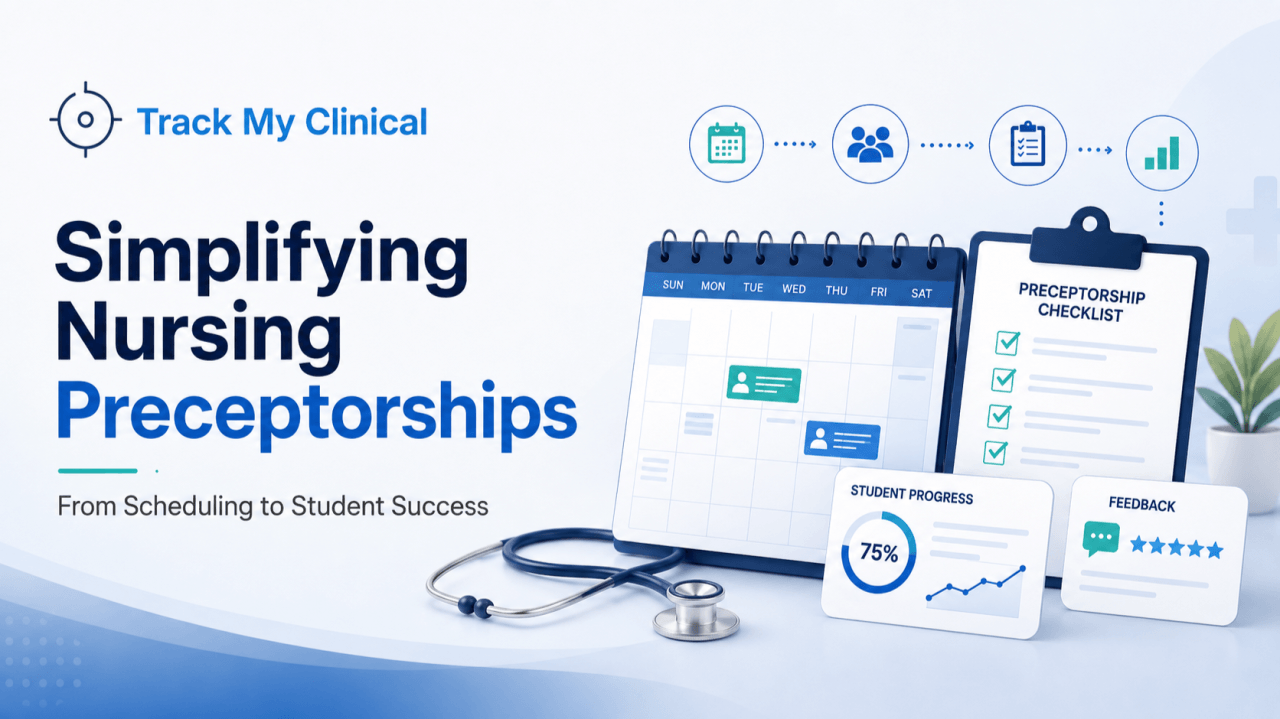
Preceptorships are an important part of nursing education. They give students an opportunity to work alongside experienced nurses, strengthen clinical judgment, and begin making the transition from nursing student to practice-ready nurse.
But for nursing faculty and clinical coordinators, managing preceptorships can quickly become complicated.
Students may be at different clinical sites, working different shifts, following different preceptors, and completing individualized schedules. Add clinical hours, faculty visits, evaluations, preceptor feedback, schedule changes, and program requirements, and suddenly one student can generate information across multiple spreadsheets, emails, forms, texts, and systems.
The challenge is not simply managing each of these tasks. The challenge is keeping them connected.
During our recent webinar, Simplifying Nursing Preceptorships: From Scheduling to Student Success, I shared several strategies nursing programs can use to make preceptorships more manageable while keeping the focus where it belongs: helping students become practice-ready nurses.
Start by Looking at the Entire Workflow
One of the first questions nursing programs should ask is:
Where does all of our preceptorship information live?
Consider how quickly faculty can answer a few basic questions:
- Where is this student scheduled today?
- How many clinical hours have they completed?
- What requirements are still missing?
- Have required faculty visits occurred?
- Has the preceptor provided feedback?
- Are evaluations complete?
- Is the student progressing toward course outcomes?
If answering those questions requires checking an Excel spreadsheet, searching through email, opening the LMS, finding a Google Form, and contacting another faculty member, the problem may not be the people involved.
It may be the workflow.
Instead of thinking about preceptorship management as a collection of individual tasks, consider it as one connected process:
Placement → Schedule → Hours → Faculty Visits → Feedback → Evaluation → Progress
Ideally, information should follow the student through each step.
Make Student Progress Easy to See
Faculty should not have to investigate every student individually to determine who needs attention.
A good process should make it easy to identify students who are progressing appropriately and, perhaps more importantly, quickly recognize when something is missing.
For example, a student may be accumulating the required clinical hours but still be missing a faculty visit or preceptor evaluation. Another may have completed all required documentation but be falling behind on clinical hours.
Early visibility gives faculty an opportunity to intervene before a small issue becomes a significant problem near the end of the rotation.
The goal should be to manage exceptions instead of chasing every task.
Set Expectations Before Day One
Technology and workflows can help organize a preceptorship, but they cannot replace clear communication.
One of the most effective ways to prevent problems is to establish expectations before the student ever arrives at the clinical site.
Students and preceptors should understand:
- Scheduling expectations
- Attendance policies
- Roles and responsibilities
- Who to contact with questions or concerns
- How schedule changes should be handled
- What happens if there is low census or a cancelled shift
- How and when feedback should be provided
- Which skills students may perform
- What level of supervision is required
It is also helpful to discuss the "what ifs" ahead of time.
What happens if the preceptor calls off? What if the student's schedule changes? What if there is a professionalism concern? What if the student is struggling?
Providing clear guidance before these situations occur helps everyone respond more consistently.
Give Preceptors Tools to Teach, Not Just Supervise
Preceptors are experienced clinicians, but many have never received formal education about how to teach a nursing student.
We can support them by giving them simple strategies that encourage clinical judgment.
Instead of only telling students what to do, encourage preceptors to ask questions such as:
- What are you noticing about your patient?
- What concerns you most?
- What do you think is happening?
- What would you do first?
- What additional information do you need?
- What would make you change your plan?
These questions require students to explain their thinking rather than simply complete a task.
That is where much of the learning occurs.
Replace Busywork With Meaningful Clinical Reflection
We should also periodically ask whether our clinical assignments are helping students develop as nurses or simply giving them more paperwork.
Rather than asking students to document everything they did during a clinical day, consider asking fewer, deeper questions.
What patient cue stood out to you today? What did you think it meant? What did you do in response, and why? What would you do differently next time?
Technology Should Reduce the Work Around Relationships
There is one thing technology cannot do: create more clinical sites or magically produce more willing preceptors.
Those challenges require partnerships and relationships between nursing programs and healthcare organizations.
What technology can do is reduce the administrative work surrounding those relationships.
A connected system can help programs organize existing placements, maintain schedules, verify clinical hours, collect evaluations and preceptor feedback, identify missing requirements, monitor progress, and make information accessible for reporting and accreditation.
That philosophy has been central to how we developed Track My Clinical.
We believe technology should not add another system for faculty to manage. It should reduce the number of places they have to look for answers.
Technology doesn't replace relationships. It reduces the work around them.
The Goal Is Bigger Than Better Scheduling
Ultimately, improving preceptorship management is not really about creating a better calendar, tracking another form, or eliminating a spreadsheet.
It is about creating an environment where faculty spend less time searching for information and more time supporting students.
It is about giving preceptors the tools they need to help students think like nurses.
And it is about creating clinical experiences that intentionally move students toward becoming safe, confident, practice-ready nurses.
That is the outcome that matters most.
Watch the Webinar
Want to hear more about these strategies and see how a connected preceptorship workflow can work in practice?
Watch Simplifying Nursing Preceptorships: From Scheduling to Student Success, presented by Megan McDowell, DNP, MSN, RN, CNE, nurse educator and co-founder of Track My Clinical.